
According to Vastu Shastra principles, the directional movement of materials, personnel, and operations within commercial and industrial facilities including factories, warehouses, offices, and retail establishments significantly influences energy circulation, operational efficiency, profitability, and overall functionality.
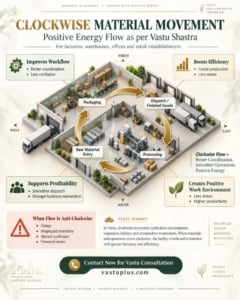
A fundamental concept within this framework is: Clockwise Material Movement = Positive Energy Flow
When raw materials, finished goods, personnel, or production processes traverse in a clockwise direction, this practice is theorized to facilitate:
- Enhanced workflow coordination and synchronization
- Accelerated production throughput and material progression
- Reduced operational confusion and process impediments
- Harmonious energy distribution throughout the facility
- Elevated productivity metrics and financial performance
- Strengthened interdepartmental collaboration and cohesion
Empirical observations from numerous high-performing manufacturing facilities demonstrate that operational organization and efficiency naturally improve when movement patterns adhere to a clockwise trajectory.
The Significance of Clockwise Movement in Vastu
Vastu philosophy maintains a fundamental connection with the circulation of natural energies throughout the environment.
From the perspective of energy flow in Vastu doctrine, the Earth’s rotation follows a clockwise pattern, and numerous traditional Indian sacred ceremonies similarly adhere to clockwise motion because it represents:
- Development
- Expansion
- Advancement
- Constructive momentum
- Equilibrium
Consequently, religious observances such as temple circumambulation, fire rituals, and devotional practices performed around sacred structures all incorporate clockwise movement.
Equally significant, when material flow within an industrial facility operates according to a clockwise pattern, Vastu philosophy posits that commercial energy circulates with greater efficiency and harmony.
Effects of Proper Clockwise Movement in Industries
1. Mitigates Operational Inefficiency
When movement patterns lack organization or proceed in counter-clockwise directions:
- Worker collisions occur with increased frequency
- Material handling operations become unnecessarily complicated
- Operational delays accumulate
- Inventory becomes subject to misplacement
- Employee stress levels elevate Clockwise workflow organization establishes systematic procedures and operational transparency.
2. Enhances Production Efficiency A structured circular operational flow facilitates:
- Accelerated order fulfillment
- Streamlined loading and unloading procedures
- Improved equipment synchronization
- Minimized material waste
- Eliminated redundant movements
These factors collectively enhance operational productivity.
3. Facilitates Financial Performance
According to Vastu principles, restricted movement patterns frequently correlate with constrained financial performance.
When goods circulate efficiently:
- Order processing accelerates
- Payment collection expedites
- Product delivery occurs punctually
- Commercial momentum strengthens
Vastu specialists frequently observe that manufacturing facilities exhibiting deficient internal circulation patterns consistently encounter recurring operational and financial challenges.
4. Cultivates Positive Workplace Environment
Disorganized facility layouts generate psychological strain.
Employees may experience:
- Irritation
- Mental exhaustion
- Reduced concentration
- Diminished productivity or lethargy
Clockwise circulation patterns establish a psychologically conducive work setting where personnel demonstrate enhanced organizational awareness and increased engagement.
Ideal Clockwise Factory Flow as per Vastu
A commonly preferred Vastu flow is:
Raw Material Entry
➡ From South, Southwest, or West zones
Processing Movement
➡ Gradually circulate clockwise through production areas
Finished Goods
➡ Move toward North, Northeast, or East dispatch zones
This symbolizes:
- Heavy energy entering from stable zones
- Lighter finished energy moving toward growth zones
Exemplification of Optimal Clockwise Circulation
Consider the following operational sequence:
1. Raw material ingress occurs from the Western direction
2. Processing operations commence in the Southern or Southeastern zone
3. Packaging activities are conducted in the Northwestern region
4. Distribution proceeds toward the Northern or Eastern direction This arrangement establishes an efficient clockwise flow pattern.
Common Problems When Movement Is Anti-Clockwise
Numerous sectors experiencing persistent operational challenges demonstrate the following characteristics:
- Inadequate directional coordination among personnel and processes
- Reverse material progression through production systems
- Counterclockwise workflow patterns
- Unstructured inventory management protocols
These deficiencies frequently result in:
- Extended processing timelines
- Necessity for process repetition
- Equipment downtime incidents
- Interpersonal disputes among staff members
- Reduction in stock value and availability
- Increased financial strain on operations
Concluding Remarks
A manufacturing facility transcends mere physical infrastructure. It constitutes a dynamic energetic ecosystem.
When the circulation of materials aligns with Vastu principles, the organization frequently experiences enhanced synchronization, tranquility, operational efficiency, and financial performance.
Unobstructed clockwise circulation represents:
- Development
- Scaling
- Resilience
- Sustained organizational advancement
For numerous sectors, optimizing internal circulation patterns emerges as the decisive factor distinguishing persistent operational challenges from seamless organizational achievement.
Not sure how your own home reads?
Everything on this page is general guidance. What it means for your home depends on which way it faces, where the entrance falls and what sits in each zone. Send a floor plan and a compass reading and get a straight answer on what to correct first. Nitien Parmar has been reading plans since 1991, in India and for families overseas.
Our Valued Clients


